Indian exporters supplying steel, aluminium, cement, fertilisers and other carbon-intensive goods to the European Union are increasingly receiving detailed carbon-data requests from customers.
A typical request may ask for the product’s CN code, manufacturing route, raw-material consumption, electricity use, fuel records, production quantity and embedded carbon emissions. In some cases, the European buyer may also request independently verified emissions information.
These requests are connected to the European Union’s Carbon Border Adjustment Mechanism, commonly known as CBAM.
CBAM moved into its definitive phase on 1 January 2026. The earlier transitional period operated from 1 October 2023 to 31 December 2025. During the transitional period, importers primarily submitted emissions reports. From 2026, CBAM also introduces a financial obligation through the purchase and surrender of CBAM certificates.
The legal obligation generally falls on the EU importer or its authorised CBAM declarant. However, most of the information required to calculate embedded emissions is controlled by the manufacturer outside the European Union.
For this reason, CBAM compliance in India is becoming a practical market-access requirement for manufacturers and exporters supplying covered goods to European customers.
What Is CBAM?
CBAM is an environmental policy introduced by the European Union to apply a carbon cost to certain imported products.
European manufacturers operating under the EU Emissions Trading System may have to bear a cost for their greenhouse gas emissions. CBAM is intended to create a comparable carbon-cost mechanism for specified goods imported from countries outside the European Union.
The mechanism is designed to reduce the risk of carbon leakage. Carbon leakage may occur when production shifts to a country with comparatively lower carbon constraints or when EU-made products are replaced by more carbon-intensive imports.
Under the definitive CBAM system, an authorised EU declarant must report the embedded emissions of covered imported goods and surrender the corresponding number of CBAM certificates.
The Indian exporter normally does not purchase these certificates. However, its emissions intensity can affect the number of certificates required by the European importer and, indirectly, the total landed cost of the product.
This creates a direct commercial connection between manufacturing efficiency in India and the cost of supplying products to the European market.
What Changed From 1 January 2026?
CBAM entered its definitive phase on 1 January 2026.
This means the mechanism is no longer limited to quarterly transitional reporting. Covered EU importers must now operate under the authorisation, declaration and certificate requirements applicable to the definitive system.
The first annual CBAM declaration for goods imported during 2026 must be submitted by 30 September 2027. The corresponding CBAM certificates for those 2026 imports must also be surrendered by that date. (Taxation and Customs Union)
Indian exporters should not treat 30 September 2027 as their working deadline.
European importers need emissions information much earlier to estimate their liability, decide whether to use default or actual values, arrange verification and maintain the required supporting records.
The European Commission’s preliminary data for imports reported from 1 January to 6 January 2026 covered approximately 1.66 million tonnes of goods. Iron and steel represented around 98 percent of the reported volume in that initial reporting window. Although this was only an early snapshot, it shows the immediate scale of CBAM implementation in the metals sector.
Which Products Are Covered Under CBAM?
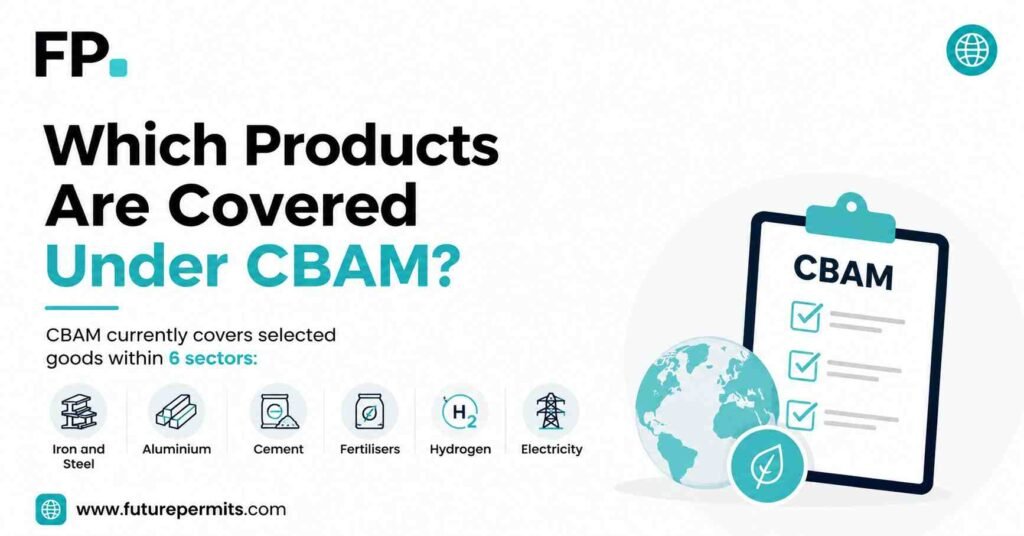
CBAM currently covers selected goods within 6 sectors:
- Iron and steel
- Aluminium
- Cement
- Fertilisers
- Hydrogen
- Electricity
Not every product containing steel or aluminium is automatically covered. Applicability depends on whether the product’s specific EU Combined Nomenclature code is included within the CBAM regulation
For example, a raw steel product may be covered while another finished engineering product may fall outside the current scope. Two products that appear commercially similar may also have different customs classifications.
Indian exporters should therefore avoid confirming CBAM applicability based only on a general description such as:
- Steel component
- Aluminium product
- Engineering item
- Fabricated structure
A proper review should consider the product specifications, material composition, manufacturing process, intended use, Indian HS code and the EU CN code declared during import.
Difference Between an HS Code and a CN Code
Indian exporters generally use an HS or ITC-HS code on shipping and customs documents.
The European Union uses the Combined Nomenclature, known as the CN. The CN system builds on the international 6-digit Harmonized System and adds further EU-specific classification digits.
An 8-digit Indian tariff code should not automatically be treated as the final EU CN code.
The European buyer or importer should confirm the classification used at the time of import. Where classification is unclear, product drawings, technical specifications, material details and intended use may need to be reviewed.
This classification step is important because an incorrect code can lead to 2 opposite problems.
A covered product may be wrongly treated as outside CBAM, creating compliance exposure for the importer. Alternatively, a product outside the scope may be unnecessarily included in a complicated emissions-data exercise.
Who Is Legally Responsible?
The EU importer or qualifying indirect customs representative generally carries the principal legal responsibility under CBAM.
The responsible party may need to:
- Obtain authorised CBAM declarant status.
- Report the quantity of covered goods imported.
- Declare the embedded emissions.
- Purchase CBAM certificates.
- Surrender the required certificates.
- Maintain evidence supporting the declaration.
An Indian manufacturer does not automatically become an authorised CBAM declarant merely because it exports goods to Europe.
However, the Indian manufacturer may be the only party capable of supplying reliable information about how the goods were produced.
The manufacturer may need to provide production quantities, process information, fuel records, electricity consumption, raw-material data, precursor emissions and calculation evidence.
Therefore, legal responsibility and data responsibility are not always held by the same organisation.
Understanding the 50-Tonne Threshold
A significant simplification introduced for the definitive phase is the annual 50-tonne mass-based threshold.
Importers bringing in less than 50 tonnes of relevant CBAM goods during a calendar year may qualify for an exemption from CBAM obligations for the covered mass-based sectors.
The threshold applies to the combined annual mass of relevant cement, iron and steel, aluminium and fertiliser goods imported by the importer.
Electricity and hydrogen are not covered by the same 50-tonne mass-based exemption. (Eur-Lex)
This threshold is assessed at the EU importer level, not separately for each Indian exporter or each individual shipment.
For example, an Indian exporter may supply only 12 tonnes of steel products to a European customer. However, if that European importer purchases another 45 tonnes from other countries or suppliers, its total relevant imports may exceed the 50-tonne threshold.
Indian exporters should therefore obtain confirmation directly from their EU customer rather than assuming that a small shipment is automatically outside CBAM.
What Are Embedded Emissions?
Embedded emissions are the greenhouse gas emissions associated with producing a covered CBAM good.
The calculation is product-specific and must follow the applicable CBAM methodology. It is not the same as a company-wide carbon footprint or a general ESG emissions report.
Depending on the sector and product, the calculation may include direct emissions, indirect emissions and emissions relating to relevant precursor materials.
Direct emissions
Direct emissions normally arise from fuel combustion and industrial processes occurring within the manufacturing installation.
Examples may include:
- Natural gas used in a furnace.
- Coal or coke consumed during metal production.
- Diesel used in defined production equipment.
- Chemical process emissions.
- Emissions generated during clinker production.
Indirect emissions
Indirect emissions generally relate to electricity consumed during the manufacturing process.
The treatment of indirect emissions can vary depending on the product category and the applicable CBAM rules. A manufacturer should not automatically use a general grid factor or claim zero emissions based only on renewable-energy certificates.
The supporting evidence and calculation conditions must be reviewed under the current CBAM methodology.
Precursor emissions
Certain manufactured goods contain input materials that are themselves covered CBAM goods.
These inputs may be treated as relevant precursors. Their embedded emissions may have to be included in the total emissions of the final exported product.
For example, a fabricated steel item may require emissions information relating to the steel used as the principal raw material.
This is one of the most difficult areas for manufacturers because the required precursor data may be held by an upstream supplier.
Default Values and Actual Values
The EU importer can use applicable default emissions values or actual emissions values in its CBAM declaration. (Taxation and Customs Union)
Default values are established for use where actual installation data is not available or where the importer chooses to rely on the prescribed default method.
Using default values may reduce the immediate data burden. However, the default value may be higher than the actual emissions of an efficient Indian manufacturing facility.
This can increase the number of CBAM certificates required by the European importer.
Actual values may better reflect the real performance of the Indian plant. They can be commercially valuable where the manufacturer uses efficient equipment, recycled materials, lower-carbon energy or an improved production route.
However, actual values require a controlled calculation process and independent verification.
A manufacturer should compare the likely commercial benefit of actual values with the effort required to prepare, maintain and verify the emissions information.
CBAM Verification Requirements
Actual embedded-emissions data used under the definitive system must be verified by an independent verifier accredited through the applicable EU accreditation framework.
A calculation prepared by an internal employee or consultant is not automatically considered verified.
Verification normally examines whether:
- The installation boundary is correctly defined.
- Production and energy data are complete.
- Emission factors are appropriate.
- Calculations follow the required methodology.
- Product allocation is reasonable.
- Precursor emissions are properly included.
- Supporting documents can be traced.
- Material errors have been identified and corrected.
A manufacturer should prepare for verification before the verifier begins reviewing the data.
Invoices, meter readings, production records and calculation sheets should be organised in a controlled evidence file. If records cannot be reproduced, actual values may be difficult to support.
Documents Indian Exporters May Need
The required documents will depend on the sector, product and manufacturing route. However, most CBAM data exercises require information from at least 5 internal functions: sales, operations, procurement, finance and compliance.
Typical company and installation documents include:
- Legal name and manufacturing address.
- Factory and production-line details.
- Process-flow description.
- Product specifications and CN codes.
- Reporting-period details.
Energy records may include electricity bills, meter readings, fuel invoices, captive-power records, steam consumption and fuel-analysis reports.
Production evidence may include batch records, monthly production reports, finished-product weight, scrap quantities, dispatch records and inventory reconciliations.
Where precursors are relevant, the business may also need supplier declarations, purchase quantities, material composition and upstream emissions information.
The calculation file should clearly identify every data source, formula, emission factor and allocation method.
Step-by-Step CBAM Readiness Process
Step 1 – Review the product
Start with the product description, material composition, technical specifications, Indian HS code and likely EU CN code.
Confirm whether the relevant CN code appears within the current CBAM scope.
Step 2 – Identify the importer
Confirm who acts as the importer of record in the European Union.
The buyer, distributor and importer may not always be the same organisation.
Step 3 – Confirm the threshold position
Ask the EU importer whether it expects to exceed the 50-tonne annual threshold.
Do not calculate the threshold using only your own shipments.
Step 4 – Clarify the customer request
Determine whether the customer needs a basic applicability confirmation, default-value support, actual emissions information or verified emissions.
Also confirm the reporting period, submission format and deadline.
Step 5 – Map the manufacturing process
Document the production route, major equipment, fuel sources, electricity meters, raw materials, precursors, scrap and finished output.
Step 6 – Complete a data-gap assessment
Compare the required CBAM information with the records currently available.
Assign each missing item to an internal owner.
Step 7 – Calculate embedded emissions
Apply the correct CBAM methodology using validated source data.
A standard product carbon-footprint figure should not be submitted as CBAM data without confirming that the calculation boundaries and rules are compatible.
Step 8 – Conduct internal validation
Reconcile the calculation with production reports, purchase records, utility bills and financial information.
Unusual variations should be investigated before data is shared with the customer.
Step 9 – Prepare for verification
Where actual values will be used, compile the monitoring plan, calculation workbook, supporting records and management approvals for independent verification.
Step 10 – Submit controlled information
Provide the EU customer with an approved and version-controlled data package.
The package should state the product, reporting period, production route, methodology, verification status and any limitations.
Case Study
An Indian manufacturer exports fabricated steel components to 3 European customers.
The company uses the same factory to produce steel components, non-CBAM engineering goods and products for the domestic market. Electricity consumption is recorded through one main meter.
One European customer asks for actual embedded emissions. The second customer plans to use default values. The third customer has not yet issued a formal CBAM request.
The manufacturer initially proposes dividing the total electricity consumption by the total tonnes produced.
However, this approach may not accurately represent the different production processes. Some components require heat treatment and multiple machining stages, while others require only cutting and assembly.
The company completes a process review and divides production into 4 operational groups. It identifies machine hours, fuel use, production weight and process stages for each group.
It also requests emissions information from its main steel supplier because the steel input is a relevant precursor.
After reconciling 12 months of energy and production data, the company prepares a controlled allocation method and supporting calculation file.
The result is not simply a single carbon number. The manufacturer creates a repeatable system that can be updated annually and used consistently for all European customers.
This reduces the risk of sending conflicting figures to different buyers and improves readiness for independent verification.
Common Mistakes Made by Exporters
One of the most common mistakes is assuming that every steel or aluminium product is covered. CBAM applicability must be checked using the relevant CN code.
Another mistake is submitting company-wide Scope 1 and Scope 2 emissions as product-level CBAM emissions. These figures may provide useful background but do not automatically satisfy the CBAM methodology.
Businesses also frequently overlook precursor emissions. For many processed products, the carbon intensity of the principal input material can form a significant part of total embedded emissions.
Other common problems include:
- Mixing production and energy data from different periods.
- Using estimated fuel consumption without evidence.
- Applying an allocation method that cannot be explained.
- Claiming verified data without accredited verification.
- Sending different figures to different customers.
- Waiting until the customer’s final submission deadline.
Commercial Risks for Indian Exporters
The direct CBAM filing obligation generally belongs to the EU importer, but the Indian exporter can still face significant commercial consequences.
A European customer may use default values where actual verified data is unavailable. If the default value creates a higher certificate requirement, the customer may seek a lower price or prefer another supplier.
Poor data readiness can also cause delays during vendor approval, contract renewal and shipment planning.
Potential business impacts include:
- Repeated customer queries.
- Delayed order confirmation.
- Price renegotiation.
- Verification costs.
- Loss of preferred-supplier status.
- Pressure to reduce emissions.
- Changes to supply agreements.
CBAM should therefore be managed as a combined compliance, finance and customer-retention issue.
CBAM Readiness Checklist
Before responding to an EU buyer, confirm the following:
- The current EU CN code has been reviewed.
- The importer of record has been identified.
- The importer’s threshold position is understood.
- The manufacturing route has been documented.
- Fuel and electricity records are available.
- Production quantities can be reconciled.
- Relevant precursor data has been requested.
- The emissions methodology has been confirmed.
- Actual and default-value options have been compared.
- Verification requirements are understood.
- Customer submissions use controlled figures.
- A responsible internal CBAM coordinator has been appointed.
Conclusion
CBAM compliance in India is not limited to completing a carbon-data template.
It requires product classification, importer coordination, manufacturing information, energy records, precursor data, emissions calculations and, where actual values are used, independent verification.
The definitive CBAM phase began on 1 January 2026. The 50-tonne annual threshold may exempt certain smaller importers, but the threshold must be assessed at the EU importer level. Indian exporters should not assume that a small individual shipment is automatically exempt.
The first annual declaration for 2026 imports is due on 30 September 2027, but European customers are already collecting and reviewing supplier data.
Indian manufacturers that build a structured emissions-data system early will be better positioned to respond to customers, support actual-value reporting and demonstrate lower-carbon production where applicable.
Start Your CBAM Readiness Check
Future Permits helps exporters and manufacturers understand CBAM requirements, complete preliminary applicability screening and identify documentation or emissions-data gaps.
Where technical calculations, legal review, customs classification, verification readiness or accredited verification are required, Future Permits connects businesses with relevant independent specialist partners.
Applicability should be confirmed using the current regulation, product CN code, manufacturing information and EU import arrangement. A preliminary readiness review is not a formal legal opinion and does not guarantee acceptance by an EU buyer or authority.